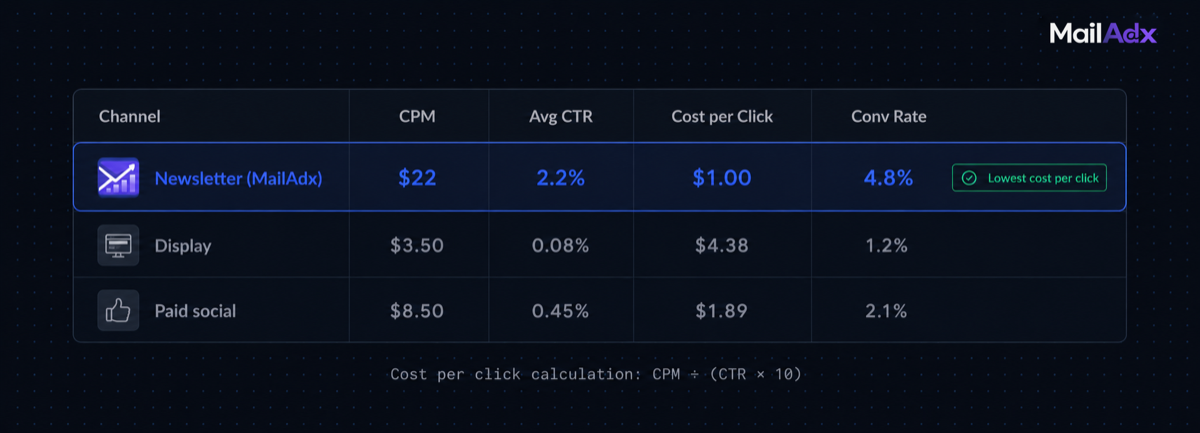
Newsletter advertising CPMs are higher than display. The natural question from marketers seeing a $22 CPM for newsletters versus $3 CPM for display is: is this worth it? The answer requires calculating beyond CPM — through click rates, conversion rates, and cost per acquired customer. When you do that math, newsletter advertising regularly outperforms display and social on cost per qualified click, and matches or beats them on cost per acquisition for audiences with high newsletter engagement. This guide explains how to calculate ROI accurately and what realistic returns look like across different campaign objectives.
What this guide covers:
Why CPM Comparisons Mislead
CPM (cost per thousand impressions) is the wrong metric for comparing newsletter advertising to other channels. It measures the cost of showing an ad, not the cost of anyone engaging with it. A channel with a $3 CPM and 0.05% CTR costs more per click than a channel with a $22 CPM and 2.2% CTR. The relevant comparison is cost per qualified action, not cost per impression.
There is a second problem with CPM comparisons for newsletter advertising specifically. MailAdx counts impressions on verified human opens — not on sends, not on Apple MPP prefetches. Other channels count impressions differently: display networks count ad renders (whether seen or not); social networks count impressions within a feed scroll.
A MailAdx newsletter impression is a subscriber who chose to open the email, loaded the email in their client, and had the ad render in their active view. A display network impression may be partially visible in a tab the user scrolled past. The quality difference is not reflected in the raw CPM number.
The Cost-Per-Click Calculation
Cost per click (CPC) is where the economics of newsletter advertising become clear. The formula: CPC = CPM ÷ (CTR × 10)
For reference, multiplying CTR% by 10 converts it to a "clicks per 1000 impressions" number. $22 CPM ÷ (2.2 CTR × 10) = $22 ÷ 22 = $1.00 CPC.
| Channel | Typical CPM | Typical CTR | Effective CPC |
|---|---|---|---|
| B2B Newsletter (MailAdx) | $22 | 2.2% | $1.00 |
| Display (Google Display) | $3.50 | 0.08% | $4.38 |
| LinkedIn Sponsored | $85 | 0.4% | $21.25 |
| Twitter/X Promoted | $8 | 0.35% | $2.29 |
| Facebook/Instagram | $9 | 0.5% | $1.80 |
At the CPC level, B2B newsletter advertising through MailAdx is competitive with Facebook/Instagram and significantly cheaper than LinkedIn and display. For B2B advertisers who historically concentrated budget on LinkedIn because of professional targeting, newsletter advertising frequently offers a comparable audience at dramatically lower CPC.
Calculating Cost Per Acquisition
CPC only accounts for click quality in aggregate. To calculate cost per acquisition (CPA), you need your post-click conversion rate for newsletter-sourced traffic.
Formula: CPA = CPC ÷ Conversion Rate
Example: $1.00 CPC × 4.5% conversion rate (trial signup) = $22.22 CPA.
Newsletter-sourced conversion rates are generally higher than display-sourced conversion rates because the visitor arrived from a context of active, relevant reading rather than passive browsing. An attentive reader of a DevOps newsletter clicking on a monitoring tool ad has higher purchase intent than an anonymous display audience member.
Observed conversion rate ranges for newsletter-sourced traffic by campaign type:
| Campaign Type | Typical Conversion Rate |
|---|---|
| SaaS free trial signup | 3.5–6.5% |
| Lead magnet download | 8–15% |
| Demo request | 2–4% |
| Webinar registration | 5–10% |
| E-commerce purchase | 1.5–3.5% |
These ranges reflect performance across MailAdx advertiser campaigns with proper audience-product alignment and well-executed creative. Below-par creative or poor audience fit will produce lower conversion rates; strong alignment and compelling creative can exceed the upper end of these ranges.
ROI Benchmarks by Campaign Objective
ROI calculation requires knowing your revenue-per-conversion. Three examples:
SaaS free trial with 12% trial-to-paid conversion:$50 ACV monthly × 12% = $6 expected revenue per trial signup. CPA of $22 at these numbers = negative first-month ROI. But factoring LTV (12-month retention at $50/month = $600 LTV), a $22 CPA represents 27× LTV return — highly positive over the subscription lifetime.
E-commerce average order value $85:At $1.00 CPC, 2% conversion rate: CPA = $50. Margin on $85 order (assuming 50% margin) = $42.50. First transaction ROI is negative. With repeat purchase rate of 3× per year, lifetime value is $255, making $50 CPA acceptable.
B2B software demo → 15% close rate → $2,400 ACV:$1.00 CPC, 3% demo conversion rate: CPA demo = $33. $33 × (1/0.15) = $220 cost per closed deal. Against $2,400 ACV, that's 10.9× return in year one — before renewals.
The pattern: newsletter advertising ROI is almost always positive when evaluated against LTV rather than first-transaction revenue, and particularly strong for SaaS and high-retention products.
Attribution: Measuring What Actually Converts
Newsletter attribution requires UTM parameters on every click URL. Without UTMs, clicks from newsletter campaigns show as "direct" in your analytics — invisible to ROI measurement.
Standard UTM setup:utm_source=newsletter&utm_medium=email&utm_campaign=[campaign-name]&utm_content=[placement]
With UTMs in place, your analytics tool attributes conversions to the newsletter source. Cross-reference this with MailAdx's click count from the reporting dashboard to verify tracking accuracy — MailAdx clicks and your analytics sessions from the UTM source should be within 5–15% of each other (some attrition from ad blockers and slow page loads is normal).
For a complete guide to campaign measurement and reporting interpretation, see newsletter ad reporting.
Improving ROI: Which Levers Move It Most
ROI = Conversion Rate × Revenue Per Conversion ÷ Cost Per Click. Each component can be improved:
CTR improvement (reduces CPC): Creative optimisation — more specific headline, clearer CTA, better audience-product alignment. CTR improvement of 0.5 percentage points (e.g. 2.0% to 2.5%) reduces CPC by 20%.
Conversion rate improvement: Landing page optimisation, offer refinement, CTA alignment between ad and page. A 1% improvement in conversion rate at a $1.00 CPC reduces CPA by $25 for a campaign currently at $100 CPA.
Audience quality improvement: Targeting more specific newsletters with better audience-product fit. A 20% CTR improvement from better targeting reduces CPC by 20%. See the targeting guide for newsletter selection criteria.
Channel Comparison Summary
Newsletter advertising sits at a specific point in the channel landscape:
Better than display on: CPC, audience quality, brand safety, ad blocker immunity, and targeting precision for niche professional audiences.
Comparable to social on: CPC (roughly), reach scalability (lower absolute ceiling but more targeted), creative production requirements.
Better value than LinkedIn for: B2B professional audience reach at lower CPC. LinkedIn wins on reach scale and job-title targeting granularity.
Complementary to search: Newsletter advertising is typically higher in the funnel than search — it creates awareness that search then captures. Publishers who see high branded search volume often find newsletter advertising is contributing to it.
Frequently Asked Questions
How long should I run a campaign to have meaningful ROI data?
Minimum 4–6 weeks for direct response campaigns — this generates enough click volume to draw statistical conclusions about conversion rate. For SaaS with a trial period, factor in the trial-to-paid window (often 14–30 days) when setting your evaluation timeline.
How do I handle newsletter advertising in a multi-touch attribution model?
Newsletter advertising typically appears as an "upper funnel" or "assist" touchpoint in multi-touch models — it creates awareness that other channels (search, retargeting) then convert. First-touch and linear attribution models tend to show better newsletter ROI than last-touch models. If you're seeing weak newsletter ROI in last-touch attribution, compare it to a linear model before drawing conclusions.
Measure your newsletter campaign ROI
MailAdx's reporting dashboard shows verified impressions, clicks, and CTR. Add UTMs for full conversion attribution in your own analytics.


